

Table of Contents
The first time I visited Dong Ho painting village, I almost drove past it. No big sign, no entrance gate, no tourist infrastructure announcing that I’d arrived somewhere significant. Just a narrow lane, a few quiet workshops, and the sound of someone pressing a wooden block against paper in a room off the road.
That understated quality is, I think, exactly what Dong Ho painting is. It doesn’t announce itself. It doesn’t need to. For over four centuries, this folk art has carried the weight of Vietnamese life – its humor, its grief, its stubborn optimism – on sheets of handmade paper so beautiful they seem to glow. And most people living in Vietnam today have never actually seen where it comes from.
This is my attempt to change that, at least a little.
So What Exactly Is Dong Ho Painting?
The short answer: it’s a style of Vietnamese folk woodblock printing, made by hand, using natural pigments, on a handmade paper coated with powdered sea shells. That last part is what gives every authentic Dong Ho painting its signature shimmer – hold one up to the light and the surface seems to glow softly from inside.
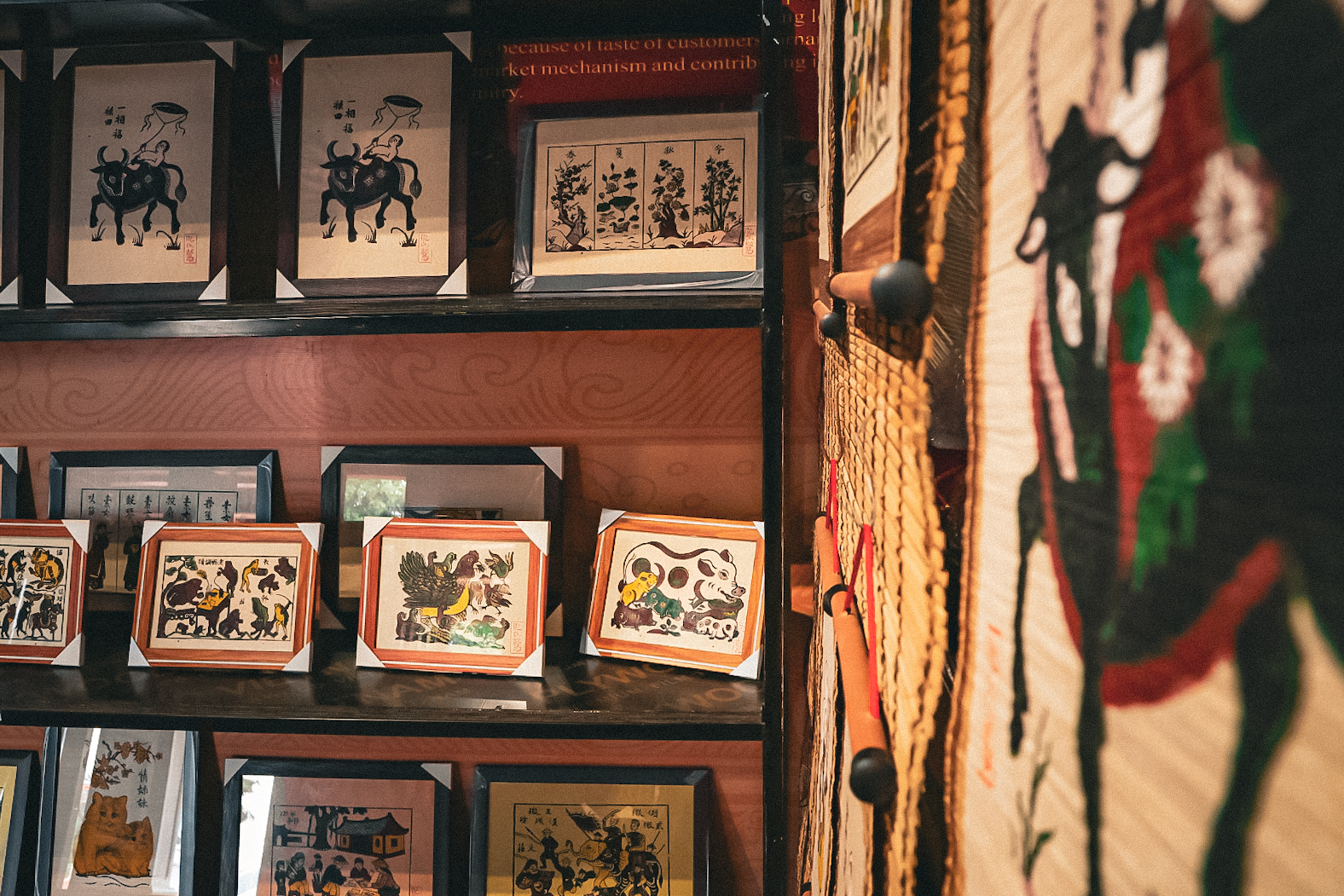
The longer answer is harder to give in a few sentences, because Dong Ho painting isn’t just a technique. It’s a whole visual language that Vietnamese people developed over centuries to talk about the things that mattered most to them: good harvests, big families, corrupt officials, funny animals, legendary heroes, the passage of seasons. Every image means something. Nothing is decoration for its own sake.
The name comes from the village: Đông Hồ, in Song Ho Commune, Thuan Thanh District, Bac Ninh Province – about 33 kilometers east of Hanoi, sitting on the south bank of the Duong River. That’s where the tradition started, probably sometime in the 16th century (though some historians push the origin back to the Ly Dynasty, in the 11th century). And that, despite everything, is where a small number of families are still making Dong Ho painting today.
The Colors Come From the Earth – Literally
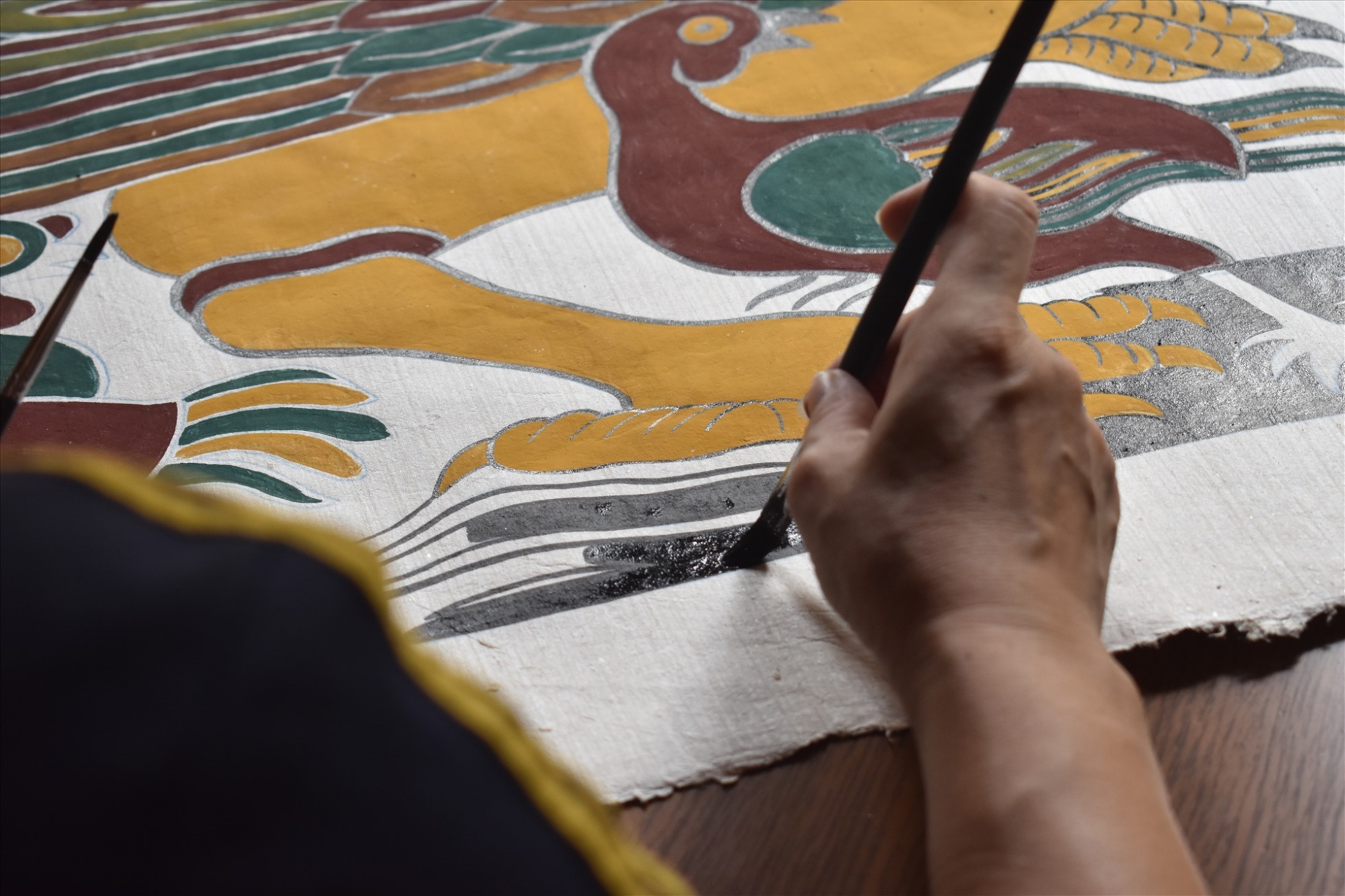
One of the first things that surprised me when I actually watched a print being made was the pigments. No paint tubes. No factory-mixed colors. The red in a Dong Ho painting comes from iron-rich mountain earth. The black comes from the ash of burned bamboo leaves. The yellow comes from flowers. The white base – that shimmery, lustrous white – is made from crushed clam and oyster shells, mixed with a paste of sticky rice, then brushed onto the surface of handmade dó paper before printing begins.
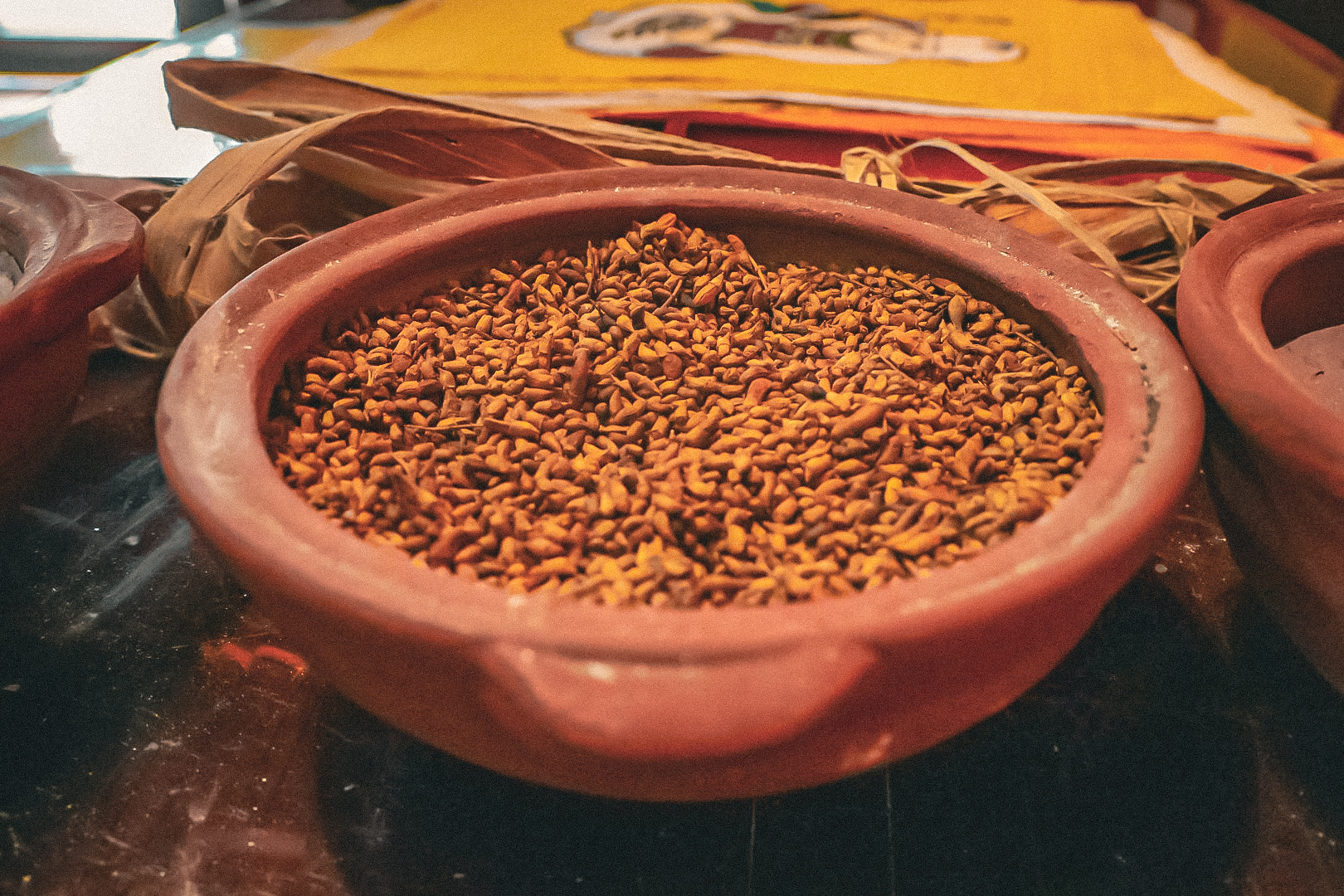
The paper itself, called giấy điệp, is made from the inner bark of the dó tree (Rhamnoneuron balansae), which grows in the Vietnamese highlands. It’s been used for centuries in Vietnam for manuscripts, documents, and votive papers, and its fibrous texture holds the shell coating beautifully. Once dried, you have a surface that drinks ink cleanly and holds color without fading – which is why old Dong Ho paintings, properly stored, still look vivid after fifty or a hundred years.
Each color in a finished Dong Ho painting requires its own carved wooden block – usually fig wood, prized for its tight grain and its ability to hold fine detail through thousands of impressions. A complex print might need five or six separate blocks, each pressed one at a time, in sequence, from lightest color to darkest. The black goes on last, laying down the outlines that pull everything into focus.
What the Images Are Actually Saying
If Dong Ho paintings were just pretty pictures, they wouldn’t have lasted this long. What kept them alive – what made families buy them year after year for Tết – is that the images carry real meaning, and that meaning spoke directly to the lives of ordinary Vietnamese people.
The most famous subjects fall into a few loose categories.
Good luck and abundance. The round pink pig, plump and content, surrounded by a litter of piglets – that’s a wish for prosperity and a large family. The carp swimming upward is a reference to the legend of the fish that transforms into a dragon, a symbol of ambition and social climbing. A rooster at dawn means a fresh start. A mother hen with chicks means fertility and protection.
These were the images people hung at New Year, the same way we might send a card saying wishing you health and happiness – except pressed by hand on shell-paper and good for the whole year.
Satire. This is the part that still surprises people when they hear it. Some of the most beloved Dong Ho paintings are sharp social criticism in disguise.
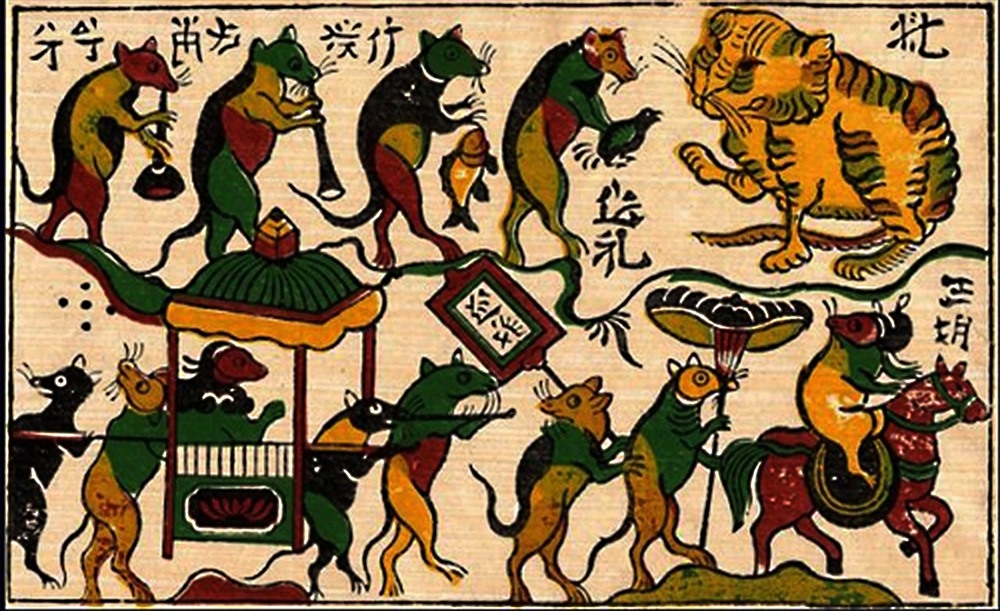
“The Mouse Wedding” (Đám cưới chuột) shows a procession of mice bringing gifts to a fat, self-important cat, just to get permission to pass by and celebrate in peace. It’s been read for centuries as a dig at corrupt officials who demanded bribes for the most basic things.
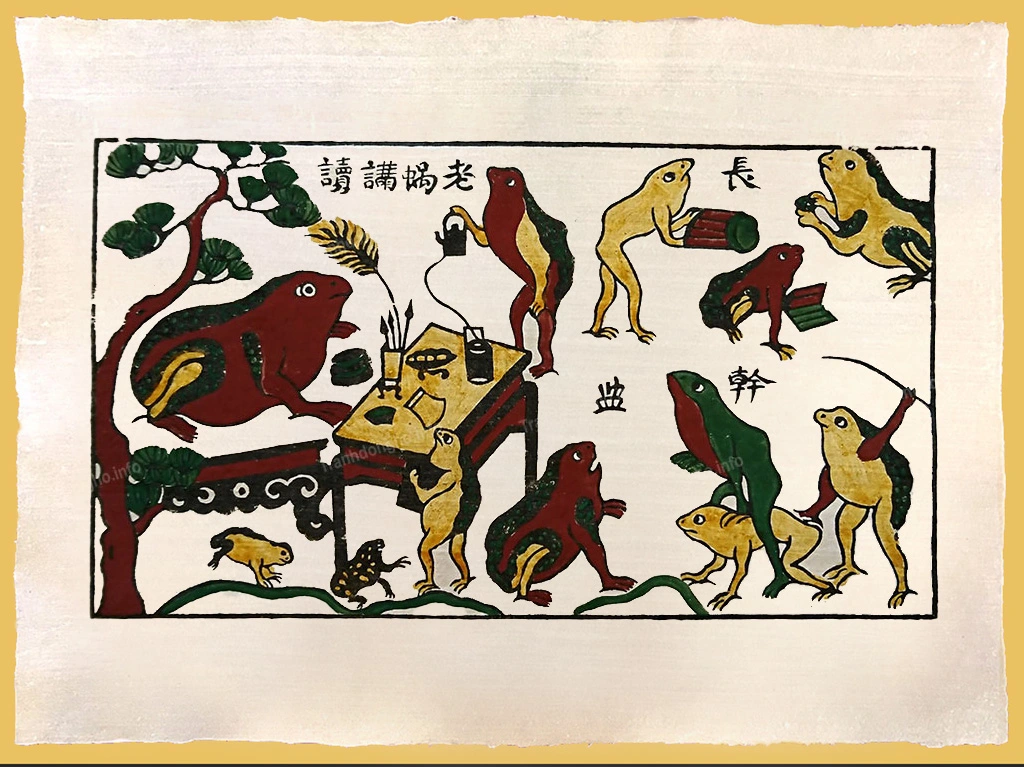
“The Toad Teacher” (Thầy đồ cóc) shows a toad presiding over a class of animals, pompously imparting wisdom – a gentle mockery of Confucian scholars who took themselves too seriously. This is folk art with edge, and it’s been making Vietnamese people laugh for four hundred years.
History and legend. Dong Ho painting also told stories: scenes from epic battles, portraits of national heroes, illustrations from Truyện Kiều, the great verse novel that every Vietnamese schoolchild still reads. For people who couldn’t read, these images were a form of popular history – bright, accessible, memorable.
The Part of This Story That Keeps Me Up at Night
Here’s the part I think people don’t talk about enough when they write about Dong Ho painting: it very nearly disappeared.
For most of the 20th century, the village was thriving – more than fifty households making prints, hundreds of different designs, enormous seasonal demand in the weeks before Tết. Then came the economic upheaval of the 1980s and the opening of Vietnam to trade, and with it, cheap printed goods from China that undercut handmade folk prints on price. Demand collapsed almost overnight. Most families in Dong Ho painting village switched to making vàng mã – paper offerings burned at funerals and ancestral ceremonies – because that’s what the market still wanted.
By the early 2000s, the number of families still producing traditional Dong Ho painting had fallen to two or three. The carved wooden blocks – each one a decades-long investment of skill and time – were being sold off, given away, or left to rot. One generation more, and the craft could have been gone.
What brought it back was slow and imperfect: some government cultural programs, some interest from Vietnamese academics and collectors, some foreign journalists and travelers who wrote about what they’d found. Dong Ho painting eventually received recognition as a Vietnamese national intangible cultural heritage, which gave it a degree of institutional protection. Young people in the village began learning the craft again – not all of them, not most of them, but some. The Nguyen Dang Che family in particular has put enormous effort into advocacy, education, and international promotion.
It’s not a triumphant comeback. It’s a fragile survival. But it is survival.
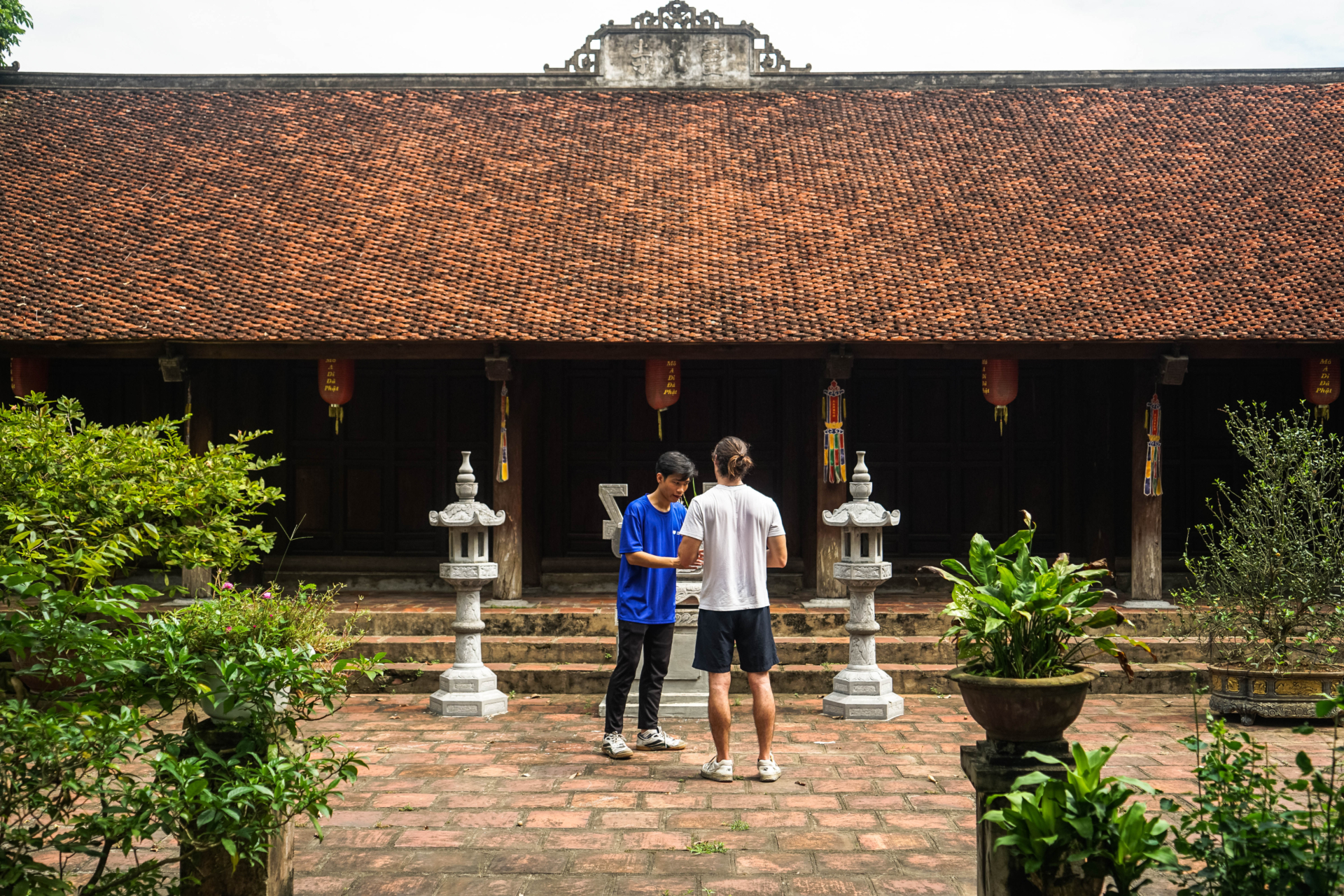
If you find yourself drawn to this kind of outing – history, countryside, things most visitors never find – you might also enjoy two of our favourite rides out of Hanoi. The Ride to the Lost Kingdom takes you by bike to Ancient Cổ Loa, the spiral citadel that was Vietnam’s first capital, through villages and rice fields that feel completely removed from the city.
Getting to Dong Ho Painting Village from Hanoi
The village is roughly 33 kilometers east of Hanoi – about an hour’s drive depending on traffic. The route takes you out through the suburbs and then into flat, green countryside: rice paddies, water buffalo, narrow roads running between villages. It’s a pleasant drive in itself.
The most comfortable option is to hire a car or taxi, which should cost around 400,000–600,000 VND for a return trip. Many people combine Dong Ho painting village with a visit to nearby Bac Ninh town, or the ancient Dau Pagoda a few kilometers away, to make a full day of it.
If you’re confident on a motorbike, the route is straightforward – follow National Highway 1A east out of Hanoi toward Bac Ninh, then turn south toward Thuan Thanh district. There are signs once you get close. This is my preferred way to go; the ride through the countryside is half the experience.
You can also join an organized cultural day tour from Hanoi, which makes sense if you want a guide who can translate and put things in context. A good guide makes a real difference in a place like this, where so much of what you’re seeing is embedded in history and craft knowledge that isn’t obvious from the outside.
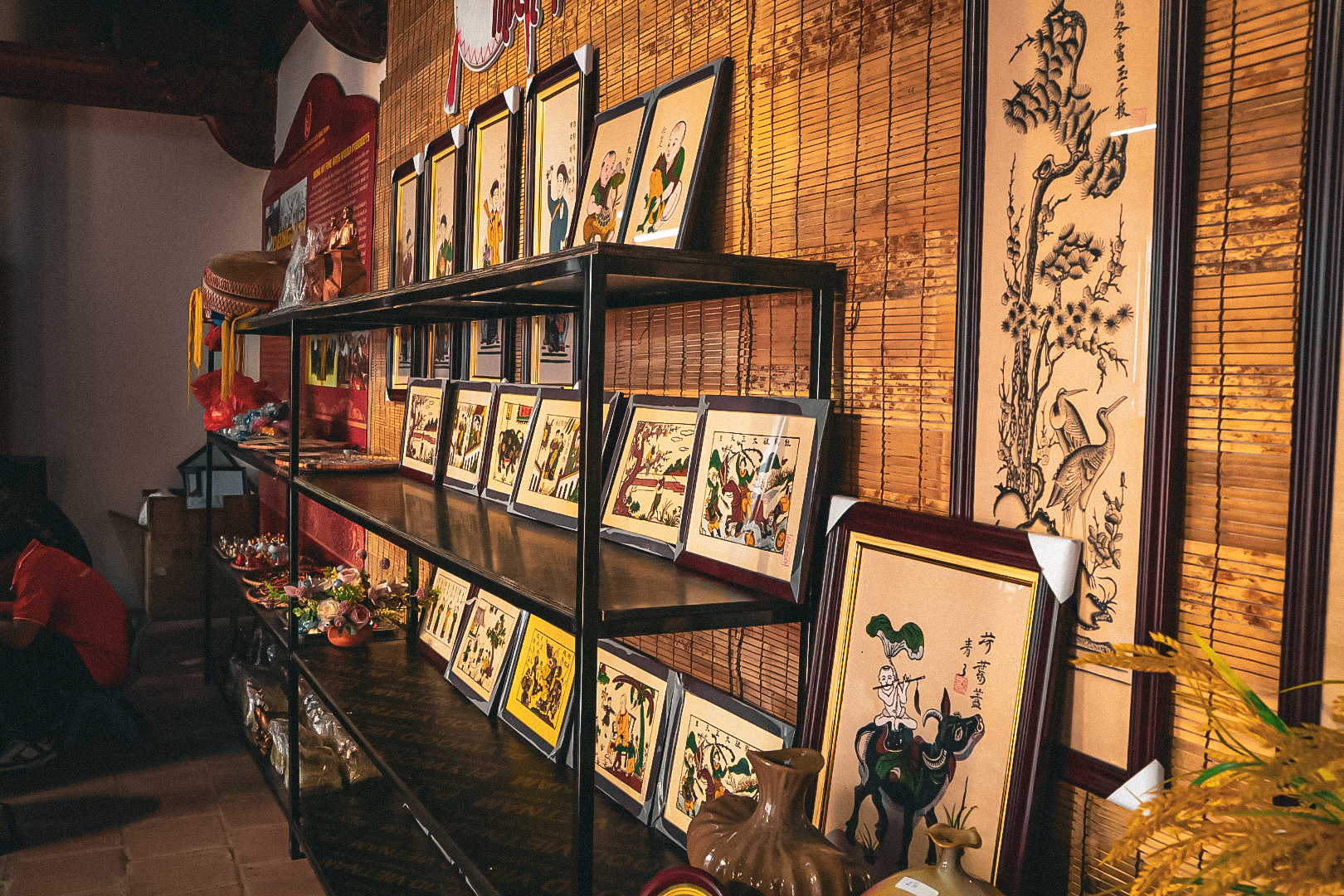
The best time to go is the three or four weeks before Tết – the village is in full production, there’s energy everywhere, and you get to see Dong Ho painting in its natural context, being made for the purpose it was always meant for. Off-season visits are quieter but still worthwhile; the workshops are open and the artisans are usually happy to spend more time with curious visitors.
If You Want to Take a Piece of It Home
My advice is simple: buy from the village if you possibly can. Prices are fair. The money goes directly to the people keeping the craft alive. And you’ll know exactly what you’re getting.
When you’re looking at prints, run your fingers lightly across the surface. Authentic Dong Ho painting on điệp paper has a very slight texture and a faint iridescence – it doesn’t look like ink on paper, it looks like something that was part of the paper to begin with. Fakes and cheap copies are printed on smooth, flat paper and feel lifeless in comparison.
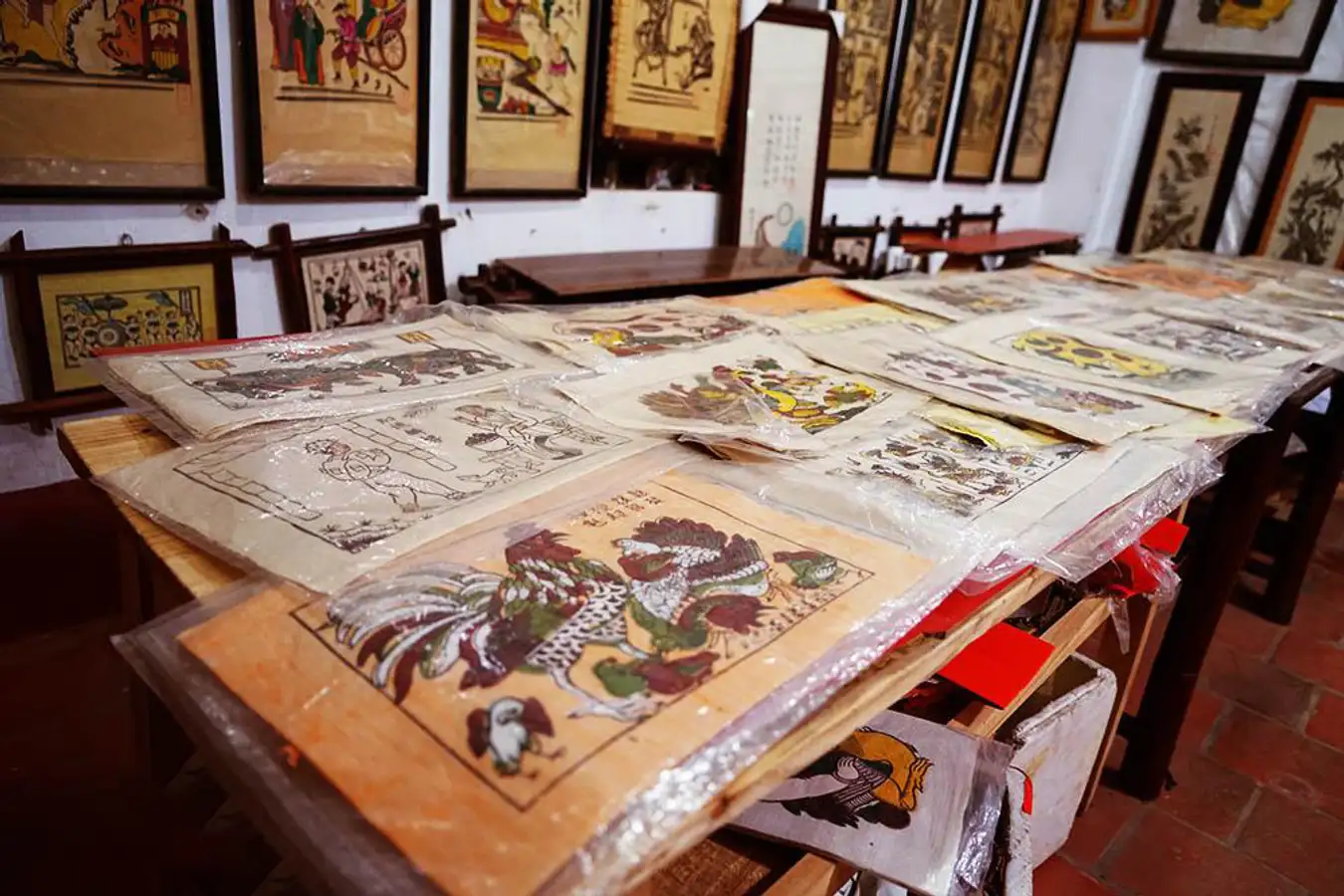
If you can’t get to the village, you can find some authentic Dong Ho painting in Hanoi – the Vietnam Fine Arts Museum has a good selection in its gift shop, and certain galleries in the Old Quarter carry genuine pieces. Hang Gai Street has some, though you have to look carefully among the tourist-grade reproductions. Avoid anything that looks suspiciously cheap and machine-perfect.
Take it home, frame it properly under glass, and hang it somewhere you’ll see it. It will last for decades. The colors won’t fade. And every so often you’ll look at it and think about the woman pressing a wooden block against oyster-shell paper in a small village by the Duong River, and it will feel like something that matters.
One Last Thing
Dong Ho painting has outlasted empires, wars, economic crises, and the slow erosion of everything handmade in a world that prefers things fast and cheap. It’s done this way because the people who make it have refused to let it go – and because enough people, when they actually encounter it, feel that it’s worth something.
If you’re in Hanoi and wondering whether it’s worth the hour’s drive – it is. Go see where Dong Ho painting comes from. Buy one if you can. Hang it on your wall. Let someone ask you about it.
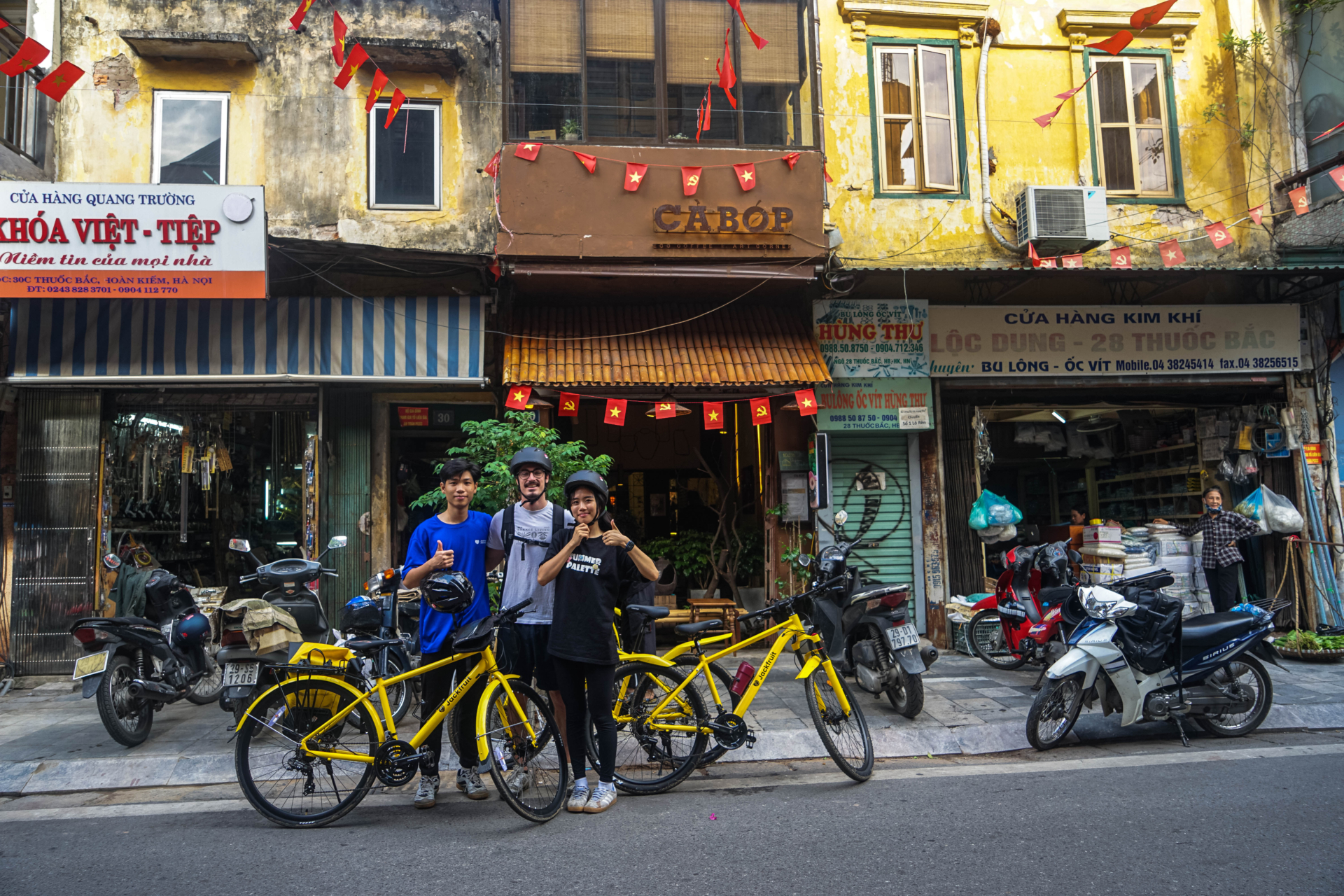
And if the drive out here has given you a taste for this kind of Hanoi – the version that exists just beyond the ring roads, in villages and river bends most people never reach – our Hanoi Cycling Tours cover a lot of that same territory, by bike.