

Table of Contents
Let me tell you a short story of the Vietnamese language – not from a textbook, not from a linguist’s desk, but from someone who grew up hearing it in a cramped Hanoi kitchen, shouted across rice paddies, and whispered between friends over a bowl of phở at 6 in the morning.
I’m from Hanoi. Vietnamese is my first language, my comfort language, and honestly, the language I still dream in. But it wasn’t until I started meeting foreign visitors – backpackers, expats, curious travelers who’d come to explore Vietnam’s culture – that I began to really see it. To notice how wild and beautiful and stubborn it actually is.
If you’ve ever tried to say “xin chào” and got a confused look from a local, you already know: Vietnamese doesn’t give itself away easily. But once it does? It’s unforgettable.
In this article, I’ll walk you through a short story of the Vietnamese language – where it came from, how it sounds, why it evolved the way it did, and what it feels like to speak it from the inside. Whether you’re planning a trip to Vietnam, learning a few phrases, or just genuinely curious, stick around. There’s a lot more to this language than six tones.
Where It All Began – The Ancient Roots of Vietnamese
A Language That Refused to Be Swallowed
A short story of the Vietnamese language has to start with a confession: for over a thousand years, Vietnam was ruled by China. A millennium. That’s not a colonial footnote – that’s deep, bone-level influence. And yet, Vietnamese survived.
The Chinese brought their writing system, their Confucian values, their administrative structures. Vietnamese absorbed a huge chunk of Chinese vocabulary – scholars estimate that around 60–70% of Vietnamese vocabulary has Sino-Vietnamese roots. Words like quốc (country), nhân (person), and vĩnh (eternal) are all borrowed Chinese sounds, adapted and transformed.
But here’s the thing: Vietnamese kept its own grammar. Its own sentence rhythm. Its own tonal logic. It bent without breaking.
This stubborn survival isn’t just linguistic trivia. For Vietnamese people, the language is a symbol of identity. When you speak Vietnamese, you’re participating in something that outlasted empires.
The Austro-Asiatic Family
Linguistically, Vietnamese belongs to the Austroasiatic language family – the same family as Khmer (Cambodian) and some tribal languages of India. This places it firmly in Southeast Asia, not East Asia, despite all the Chinese influence.
Mon-Khmer is the branch Vietnamese falls under. If you listen closely to certain Vietnamese words and compare them to Khmer, you can catch faint echoes – the bones of a shared ancestor.
The Six Tones – The Part That Makes Everyone Nervous
Why Tone Matters More Than You Think
No short story of the Vietnamese language is complete without talking about the tones. This is the part that scares every newcomer. And honestly? Fair enough.
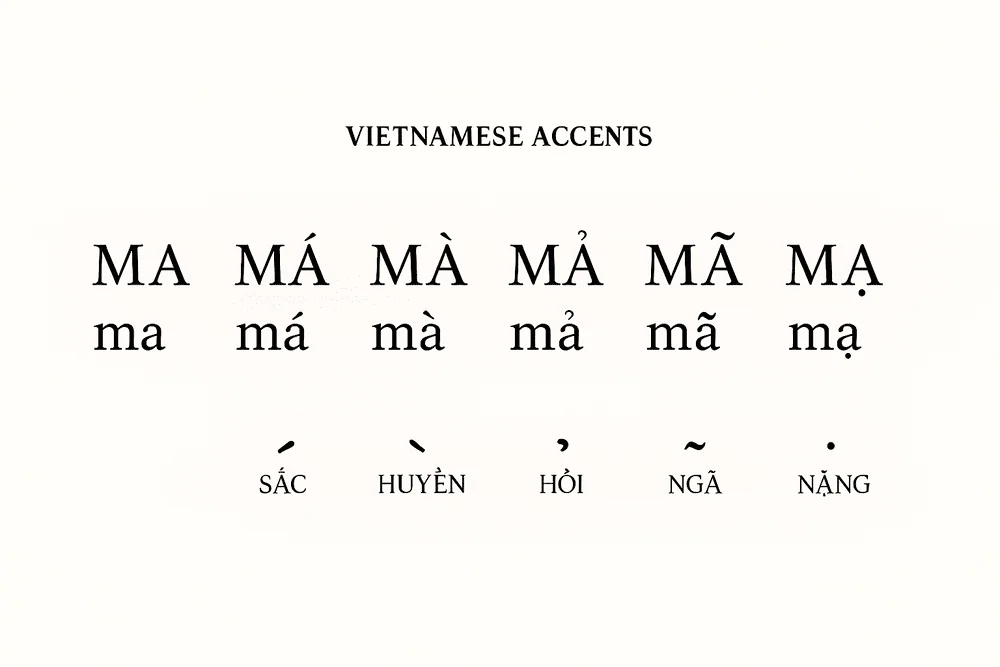
Vietnamese has six distinct tones in the northern dialect (Hanoi standard), each of which changes the meaning of a word completely:
- Flat tone (ngang): mid-level, no mark – ma (ghost)
- Falling tone (huyền): low, drawn-out – mà (but/however)
- Rising tone (sắc): sharp, rising – má (cheek/mother in southern dialect)
- Broken tone (hỏi): mid, dipping then rising – mả (tomb)
- Heavy tone (nặng): low, short, glottalized – mạ (rice seedling)
- Creaky tone (ngã): mid, rising with a glottal break – mã (horse/code)
One syllable. Six completely different meanings. Say the wrong one and you might accidentally insult someone’s grandmother instead of complimenting her cooking.
I grew up with this and it still catches me out sometimes – especially in regional dialects. The southern Vietnamese dialect in Ho Chi Minh City only uses five tones, merging two of the northern ones. It sounds smoother, more relaxed, like someone turned the intensity dial down a notch.
The Tones Feel Like Music
What I’ve come to realize, explaining Vietnamese to visitors on tours, is that the tones aren’t just pronunciation rules. They give Vietnamese its musicality. A sentence in Vietnamese has a natural melody. Rise here, fall there, cut it short, stretch it long.
Old Vietnamese poetry and folk songs – ca dao – leaned into this hard. The tones weren’t incidental to the verse; they were the verse. The sound was the meaning.
The Writing System – From Chữ Nôm to the Latin Alphabet
How Vietnamese Got Its Modern Script
This is one of my favorite parts of a short story of the Vietnamese language – the writing system. Because it has one of the most interesting evolutions of any language I know.
For centuries, educated Vietnamese wrote in classical Chinese (chữ Hán). Then Vietnamese scholars developed chữ Nôm – a system that adapted Chinese characters to represent Vietnamese sounds and words. Nôm was used for poetry, literature, and administrative documents from around the 13th century onward.
The famous Truyện Kiều (The Tale of Kiều), written by Nguyễn Du in the early 19th century, was composed in chữ Nôm. It’s still considered the masterpiece of Vietnamese literature. People quote it the way English speakers quote Shakespeare – even people who’ve never fully read it.
Then came the colonial era, and with it: the Latin alphabet.
Alexandre de Rhodes and the Romanization
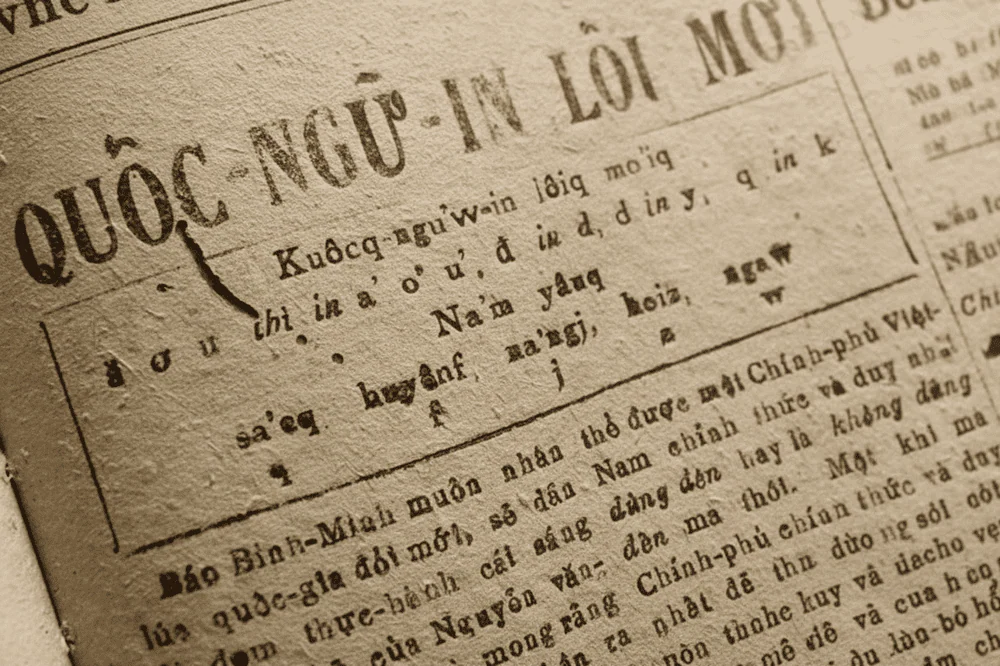
In the 17th century, a French Jesuit missionary named Alexandre de Rhodes developed quốc ngữ – the romanized script for Vietnamese. It was originally designed to help missionaries spread Catholicism. But history, as usual, had other plans.
Quốc ngữ gradually replaced chữ Nôm, especially after French colonial authorities made it the official script. By the early 20th century, it had become the standard writing system.
Today, Vietnamese is written in a modified Latin alphabet with additional letters and a complex system of diacritical marks to indicate tones. A single vowel like “a” can appear as: a, à, á, ả, ã, ạ, ă, ằ, ắ, ẳ, ẵ, ặ, â, ầ, ấ, ẩ, ẫ, ậ.
Yes. That’s a lot of hats on one letter.
Regional Dialects – One Country, Many Voices
North, Central, South: Three Ways to Sound Vietnamese
A short story of the Vietnamese language wouldn’t be honest if it pretended there’s just one Vietnamese. There isn’t.
- Northern Vietnamese (Hanoi dialect) is considered the standard – it’s used in national broadcasts, official settings, and most educational materials. Six tones, clear consonants, and a slightly formal rhythm.
- Central Vietnamese (Huế dialect, in particular) is famously difficult – even for other Vietnamese people. The tones shift, the vowels compress, and the pace quickens. I have relatives in Huế and, hand on heart, I sometimes miss words.
- Southern Vietnamese (Ho Chi Minh City dialect) has five tones, softer consonants, and a warm, open vowel quality. Southerners also use different vocabulary for everyday things – enough to cause genuine confusion in a conversation.
Ask a Vietnamese person from a different region if they understand another dialect and you’ll often get a laugh and a “mostly.”
Why Dialects Matter for Travelers
If you’re traveling through Vietnam and learning a few phrases, it’s worth knowing which region you’re visiting. “Thank you” is cảm ơn everywhere, but the accent and intonation shift significantly. Locals in Hội An will appreciate it if you at least try the local pronunciation – it shows you’ve paid attention.
The Vocabulary – Layers of Borrowed Words
Chinese, French, and Everything in Between
Any short story of the Vietnamese language needs to account for how much Vietnamese has borrowed – and how gracefully it’s worn those loans.
The Chinese layer is the deepest. Words for abstract concepts, governance, medicine, and philosophy often have Sino-Vietnamese roots. Bác sĩ (doctor), học sinh (student), xã hội (society) – all Chinese-derived.
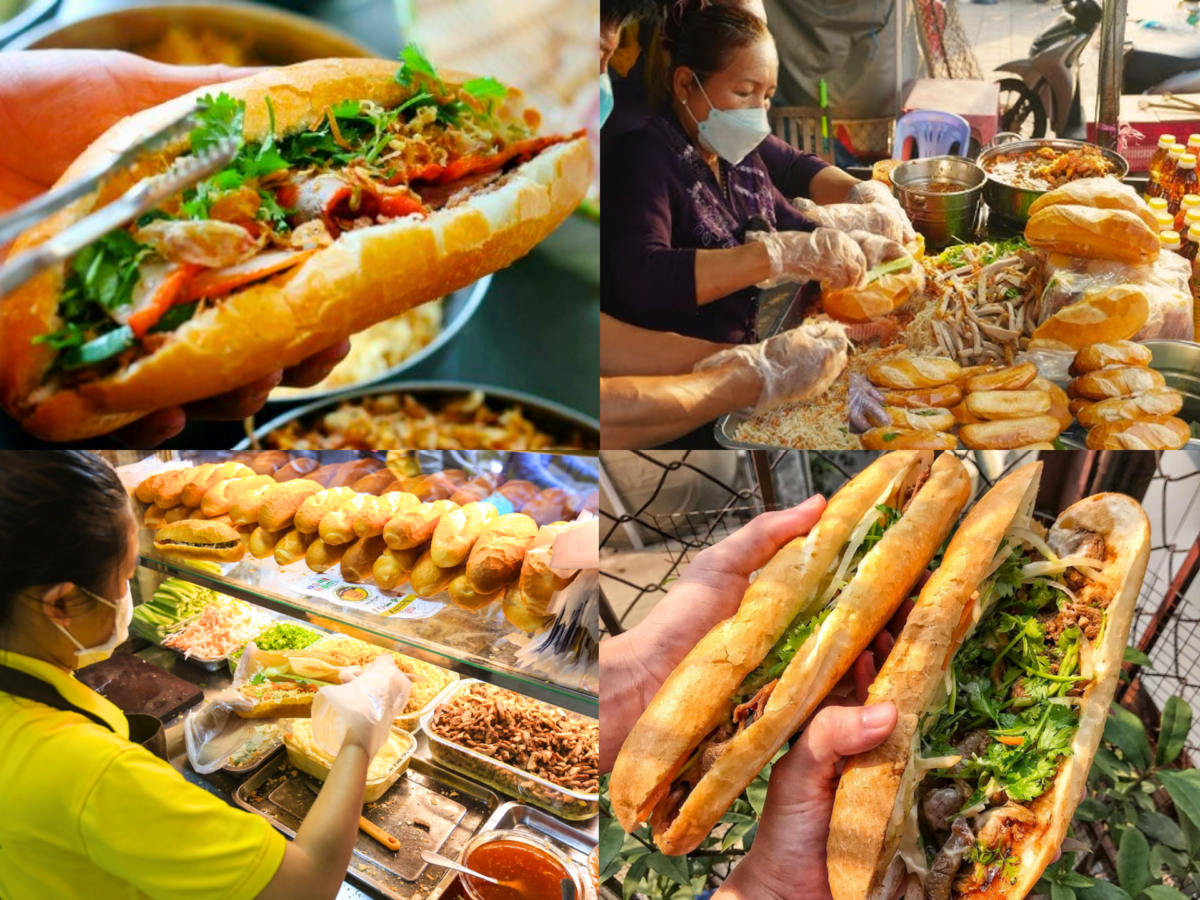
Then came the French colonial period (1858–1954), which left a lighter but still visible fingerprint. Words like cà phê (coffee, from café), bánh mì (baguette bread), ga (train station, from gare), tắc xi (taxi). These words are fully integrated now – they feel Vietnamese, even though they started in Paris.
And then there’s English, which has been flooding in since the 1990s. Email, website, smartphone, marketing – all used as-is, absorbed directly into daily speech. Younger generations in Hanoi and Ho Chi Minh City mix English and Vietnamese naturally, creating what linguists call code-switching and what my grandmother calls “talking funny.”
Vietnamese as a Living Language
How It’s Changing Right Now
The most fascinating thing about doing a short story of the Vietnamese language in the present tense is watching it evolve in real time.
Social media has turbocharged slang. Young Vietnamese online have developed an entire vocabulary of abbreviated terms, phonetic shortcuts, and borrowed English phrases that older generations simply don’t recognize. A 60-year-old reading a teenager’s messages might as well be reading a different language.
But there’s also a counter-movement – a renewed interest in chữ Nôm, in classical literature, in regional dialects that were being lost. Younger Vietnamese scholars and artists are digging back into the roots, translating Truyện Kiều into modern Vietnamese, recording elderly speakers of dying dialects.
The language is pulling in two directions at once: globalizing and preserving. I find that tension genuinely exciting.
The Emotional Weight of Vietnamese
Here’s something a textbook won’t tell you: Vietnamese is a deeply relational language. The pronoun system alone tells a story about who you are and how you relate to the person you’re speaking to.
In English, “you” is just “you.” In Vietnamese, the word you use to address someone depends on their age, your relationship, the formality of the situation, and sometimes even your own social position. You might call someone anh (older brother), chị (older sister), chú (uncle), bác (elder uncle/aunt), em (younger sibling) – and each choice carries weight.
Get it wrong and you’ve either been rude or strangely intimate. Get it right and you’ve communicated something beyond the words: I see you. I know where you stand in relation to me. I respect that.
That’s not just grammar. That’s culture baked into syntax.
What It Feels Like to Speak Vietnamese
Whenever I try to explain a short story of the Vietnamese language to someone who doesn’t speak it, I come back to this: Vietnamese is not just a way to communicate. It’s a way of being embedded in a community.
When I greet my neighbor with chào bác, I’m not just saying hello. I’m acknowledging her seniority, expressing warmth, positioning myself as someone younger who respects someone older. When I answer the phone with alo, em nghe ạ, I’m being deferential, attentive, present.
Every conversation in Vietnamese has this invisible social architecture underneath it.
And the sounds themselves – the rising tones, the nasal vowels, the sharp stops – they feel like the landscape. Like the Red River Delta: flat in some places, suddenly steep in others, always moving.
A Living History
A short story of the Vietnamese language is really a short story of Vietnam itself – resilient, layered, musical, and always in conversation with its past while rushing toward the future. From its Austro-Asiatic roots to its Chinese-borrowed vocabulary, from the beautiful complexity of chữ Nôm to the everyday Latin letters we type today, Vietnamese has survived a thousand years of pressure and come out the other side richer for it.
If you want to understand Vietnam – really understand it – start with the language. Even learning to say xin chào properly, with the right tone, is a small act of connection. And connection, after all, is what travel is really about.
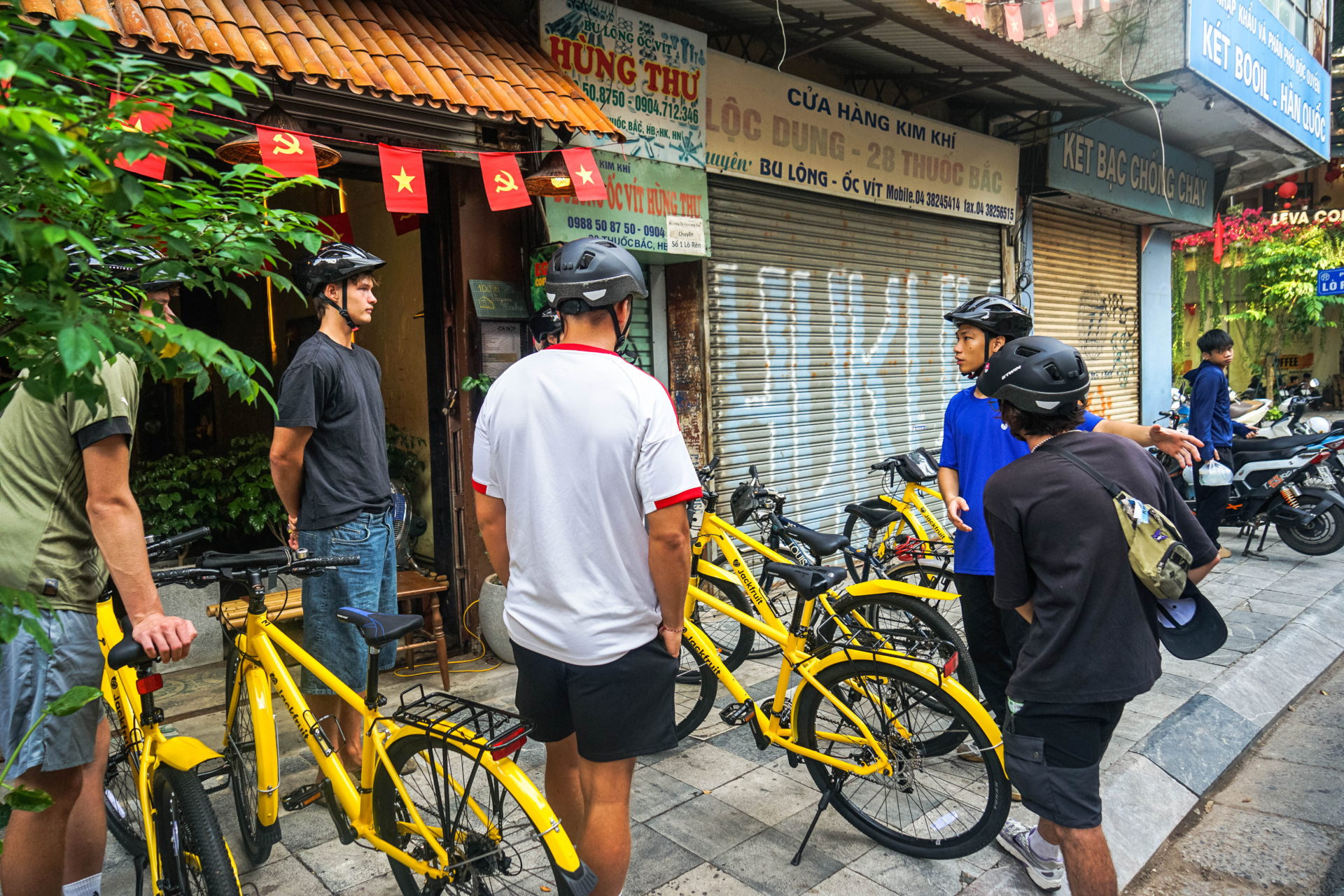
Want to experience Vietnamese culture up close, through the streets, markets, and local conversations that textbooks can’t capture? Contact us today! Jackfruit Adventure runs immersive local experiences in Hanoi and beyond – guided by people who grew up speaking this language, living this culture. Come hear it for yourself!