

Table of Contents
Vietnam’s map is changing. Over decades, the country has seen countless provincial mergers and splits, each shaping the economy, culture, and daily life of its people. Now, in 2025, the latest wave of administrative restructuring is taking place, reducing the number of provinces and cities while aiming to streamline governance and boost development. Let’s take a closer look at what’s changed after the Vietnam provincial merger, what’s stayed the same, and why it matters for Vietnam today.
Why Do Vietnam Merge Provinces and Cities?
Vietnam’s efforts to merge certain provinces and cities aim to build a more efficient and responsive government. Through the Vietnam provincial merger process, the state seeks to reduce overlapping administrative structures, cut unnecessary costs, simplify decision-making, and ease long-term financial pressures. Fewer boundaries also make it easier to coordinate development plans and focus resources on projects that bring the most benefit to communities. This approach helps improve essential public services such as infrastructure, healthcare, and education. Overall, the Vietnam provincial merger is intended to create a more streamlined government that serves people with greater consistency and care.
The History of Vietnam Provincial Arrangement Up to Today
Before 1975: A patchwork of 72 provinces
Vietnam’s administrative boundaries have changed many times throughout its history. Before reunification on April 30, 1975, the country consisted of 72 provinces: 28 in the north and 44 in the south. At this time, the central region was not official yet but managed as part of the northern and southern systems. This period laid the foundation for later adjustments, including the large-scale Vietnam provincial merger efforts that would follow.
1976: The first great consolidation
In 1976, Vietnam implemented its first major Vietnam provincial merger, consolidating many provinces to streamline governance and support national reconstruction after the war. This was the most extensive reorganization of provinces in the country’s history up to that point.
1980 – 2008: When provinces grew apart again
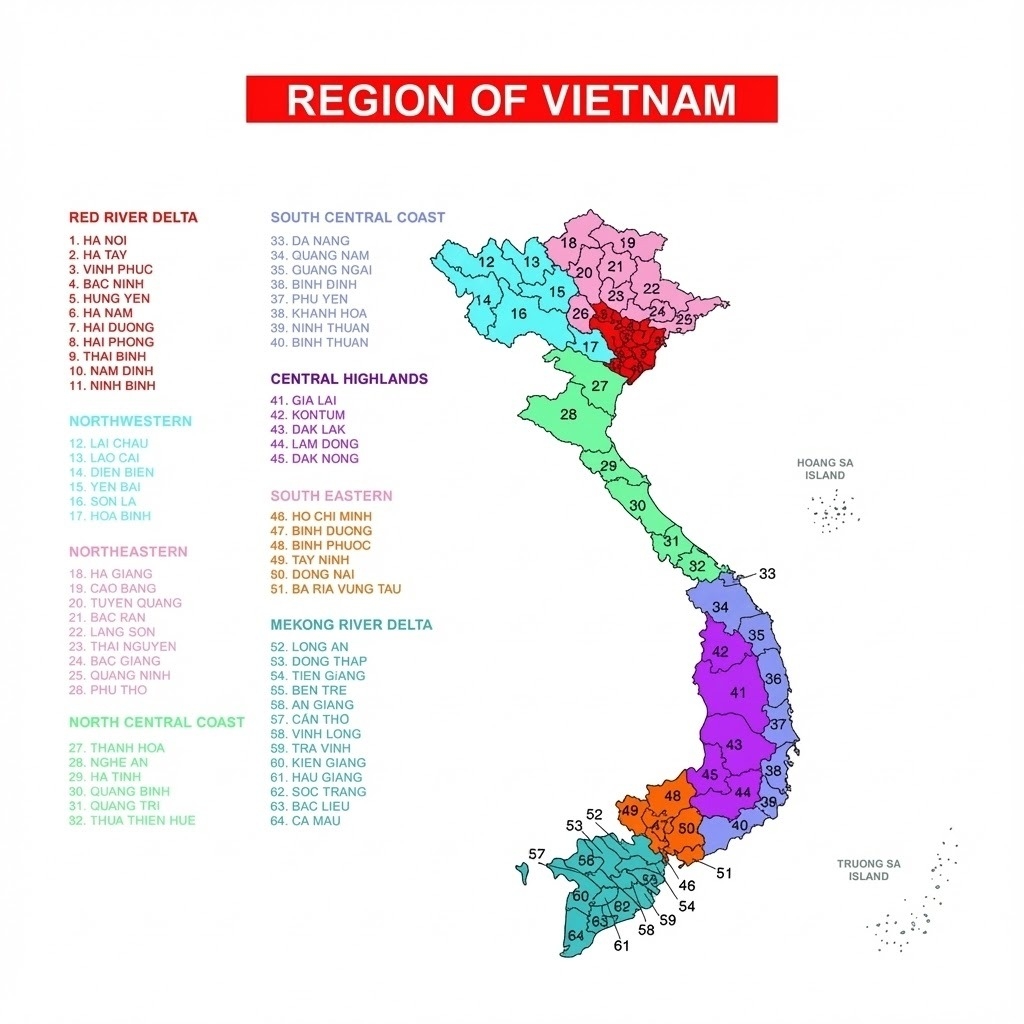
From 1980 to 2008, Vietnam saw a wave of provincial separations. These changes aligned with the rise of the market economy, which was proving effective worldwide. The government also aimed to ensure more flexible local governance that matched each region’s unique characteristics. By this period, Vietnam had 57 provinces and 6 centrally governed cities.
The map before 2025: A system ready for change
Vietnam Provincial Mergers 2025: Consolidation from 63 to 34
Resolution 60-NG/TW
In 2025, Vietnam took a big step toward reshaping its administrative landscape with the adoption of Resolution No. 60-NG/TW. This move is all about streamlining the way the country’s regions are organized to make governance smoother and more efficient. As part of the plan, the number of provincial-level administrative units has dropped significantly. Moreover, this consolidation is aimed to completely eliminate the old multi-tier bureaucracy, simplifying governance into two main levels: the Provincial Level and the local Commune Level (wards/communes).
How many provinces will Vietnam have now?
The country now has 34 provincial-level administrative units, with 21 located in coastal regions. While most provinces have undergone restructuring, only a few cities and provinces remain unchanged. However, the national alignment is still ongoing and is expected to be completed by the end of 2025.
Full List of Provinces Unchanged in 2025
11 Vietnamese provinces will remain administratively unchanged. Notably, Hanoi, one of Vietnam’s most famous and frequently visited cities, is staying the same, ensuring no disruption for its residents or confusion for tourists.
The other ten provinces that also maintain their current structure are Hue, Lai Chau, Dien Bien, Son La, Lang Son, Quang Ninh, Thanh Hoa, Nghe An, Ha Tinh, and Cao Bang.
Full List of Merged or Restructured Provinces
Northern Vietnam
- Tuyen Quang province: Tuyen Quang, Ha Giang
- Lao Cai province: Lao Cai, Yen Bai
- Thai Nguyen province: Thai Nguyen, Bac Kan
- Phu Tho province, Phu Tho, Vinh Phuc, Hoa Binh
- Bac Ninh province: Bac Ninh, Bac Giang
- Hung Yen province: Hung Yen, Thai Binh
- Hai Phong City: Hai Phong, Hai Duong
- Ninh Binh province: Ninh Binh, Nam Dinh, Ha Nam
Central Vietnam
- Quang Tri province: Quang Binh, Quang Tri
- Da Nang City: Da Nang, Quang Nam
- Quang Ngai province: Quang Ngai, Kon Tum
- Khanh Hoa province: Khanh Hoa, Ninh Thuan
Central Highlands
- Gia Lai province: Gia Lai, Binh Dinh
- Khanh Hoa province: Khanh Hoa, Ninh Thuan
- Lam Dong province: Lam Dong, Dak Nong, Binh Thuan
- Dak Lak province: Dak Lak, Phu Yen
Southern Vietnam
- Ho Chi Minh City (HCMC): HCMC, Binh Duong, Ba Ria – Vung Tau
- Dong Nai province: Dong Nai, Binh Phuoc
- Tay Ninh province: Tay Ninh, Long An
- Can Tho City: Can Tho, Soc Trang, Hau Giang
- Vinh Long province: Ben Tre, Vinh Long, Tra Vinh
- Dong Thap province: Dong Thap, Tien Giang
- Ca Mau province: Ca Mau, Bac Lieu
- An Giang province: An Giang, Kien Giang
- Ca Mau province: Ca Mau, Bac Lieu
- An Giang province: An Giang, Kien Giang
What Vietnam’s Map Looks Like Now
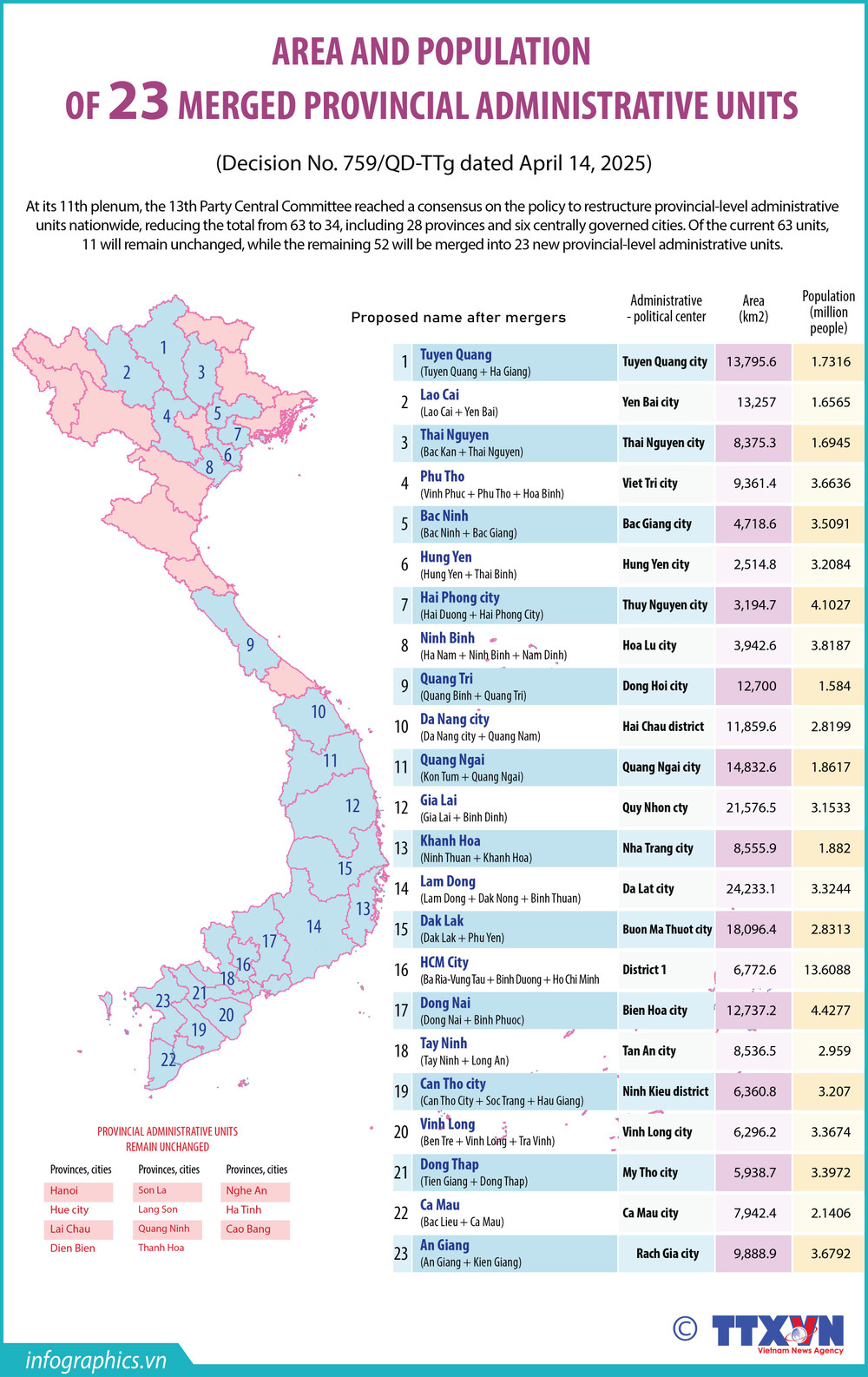
Source: TTXVN (Vietnam News Agency)
Building a More Efficient Unity: Advantages of Vietnam Provincial Merger
When you zoom out and look at the big picture, the purpose of Vietnam provincial mergers isn’t just about drawing new lines on the map. It’s part of a long-term plan to streamline governance, boost economic growth, and make life easier for both investors and locals.
1. Fewer layers, faster governance
The restructuring achieves faster governance by creating fewer administrative layers, which directly simplifies procedures and speeds up decisions. Instead of projects and policies getting slowed down by needing approval from multiple provincial authorities, there is now a single, unified regional body, creating a single point of contact for businesses and investors.
2. Enhancing logistics for stronger economic development
With the new structure, almost every province now has access to a seaport, which is a huge advantage for trade and transportation. Bigger provinces also tend to attract more investment, which means more funding to upgrade highways, ports, and essential infrastructure. Previously, each province had its own regulations, creating bottlenecks for businesses and foreign investors. The merger simplifies this landscape, making it easier to operate across regions and helping Vietnam stay competitive in the global market.
3. Administrative reform, modernization
The 2025 Vietnam provincial merger represents a strategic, forward-looking move by the Government to fundamentally reform the national administration, driving it toward a streamlined, modern, and highly effective system. This initiative is perfectly in line with the times, as the rapid development of technology and transportation networks makes managing larger administrative units much easier.
4. Improving national management
The merger also helps tidy up a management system that had grown overly complex and layered over the decades. Larger administrative units mean fewer overlapping departments and clearer responsibilities. This allows the government to coordinate policies more efficiently, reduce budget fragmentation, and direct resources where they’re needed most. In simple terms, it cuts out a lot of red tape and creates a cleaner, more manageable structure for long-term development.
How the New Provinces Affect Daily Life?
Changing Routes & Regional Mobility
In the short term, both residents and tourists in the newly merged areas may experience confusion with navigation. This is because place names will change, especially at the former district level, requiring immediate and crucial updates to official maps and GPS data. Similarly, logistics and travel will be affected: companies must re-optimize delivery and transport routes. All transportation vehicles (buses, trains, flights) will need to update their route labels and destination names to demonstrate the merged provinces.
Updating Documents & Legal Records
One of the most significant effects of the Vietnam provincial merger on daily life is the need to update legal documents linked to administrative boundaries. This is especially relevant in provinces that have recently been consolidated.
Personal Documents (Citizens, expats)
- National ID Cards/Citizen ID: Changes are currently optional until the expiry date. However, citizens can update their ID cards if needed.
- Temporary Residence Cards (TRC) & Work Permits: These documents are tied to a specific province and employer. If your residence or employer’s registered address is now under a different merged province, updates will be necessary.
- House/Vehicle Registration: Ownership and registration papers must be aligned with the new provincial names and administrative codes.
Business Records
- Business Licenses: Must reflect the new provincial/city name.
- Tax Registration: Provincial tax codes and business registration zones will change.
- Investment Certificates (IRC/ERC): Businesses should contact the Department of Planning and Investment (DPI) in the new province to confirm if amendments are required.
Implementation Timeline of Vietnam Provincial Merger in 2025
1. March 2025:
Government Restructuring: Mergers of several ministries and ministry-level agencies begin, and the abolition of district-level police.
2. April 2025:
Formal Approval: The Communist Party of Vietnam (CPV) Central Committee approves the administrative reorganization plan (Resolution No. 60-NQ/TW), setting the stage for the Vietnam province merger.
3. June 12, 2025:
National Assembly Resolution: The National Assembly passes the final resolution to officially reorganize and merge the provincial-level units, formally authorizing the reduction from 63 to 34.
4. July 1, 2025:
The New Administrative Units officially begin operation. The district level is formally eliminated, and the two-tier local governance system takes effect nationwide.
5. August 30, 2025:
Completion Deadline: The deadline for finalizing the administrative and personnel arrangements for the newly merged provinces and communes.
6. September 2025:
The newly merged provincial structures are intended to be fully operational under the new administrative structure.
7. December 31, 2025:
System Alignment: Deadline for the national alignment of related systems, such as tax, customs, treasury, and social insurance, with the new administrative map.
FAQ: What People Are Most Curious About Vietnam Provincial Merger
“My hometown no longer exists. What now?”
Your physical location still exists, but its official administrative name has changed, likely merging into a new, larger unit (e.g., a new province or city). For documents, you’ll use the new name.
“Do I need to update my passport or TRC?
Generally, no, not immediately. Your Temporary Residence Card (TRC) and passport are primarily tied to national/provincial-level authority and your registration. You only need to update your address on a new application/renewal or if you are specifically advised to by immigration officials.
“Will Google Maps get updated?”
Yes, eventually. Google Maps updates its base map data, including boundaries and place names, over time, using satellite images, official data, and user reports. The change may not be instantaneous, but it is expected.
“Will postal codes change?”
Possibly. Postal (ZIP) codes are tied to mail delivery routes and efficiency, which can be impacted by administrative restructuring. Official postal services will issue updated codes, which you should use once announced.
“Does this impact travel routes?”
Not the physical roads, but the signage and names. The physical roads and infrastructure remain the same. However, road signs, navigation, and travel guides will be updated over time to reflect the new official place names and boundaries.
What to Do If You Live or Work in Vietnam?
Important News! If you’re living in, traveling through, or planning to visit certain areas in our country, make sure you know how the Vietnam provincial merger shape boundaries and name changes. Here’s some reminders to navigate these shifts with ease and keeping your plans on track:
1. Update Your Maps and Itinerary
Street names and addresses may have changed or been duplicated (e.g., common names like Le Loi now appearing in multiple areas). So if you are a returning Vietnamese citizen, your hometown’s administrative name may have changed or merged. Save your must-visit spots and your home address on digital map services like Google Maps to utilize the latest geographic data.
2. Check Transportation Routes
Bus, train, and highway routes may change with the new provincial boundaries. I understand that disruptions are a reality during transitions, therefore the confirmation of travel schedules and routes in advance will never hurt.
3. Update Your Official Documents
As someone navigating these changes, I strongly recommend you check the status of your critical paperwork, specifically your Work Permit and Temporary Residence Card (TRC). Based on current regulations, these official papers do not require an immediate update simply because of a boundary change.
However, be aware of your document’s expiry date to see if it needs to be renewed.
4. Seek Official Guidance
From my own experience, the best way to avoid confusion is to go straight to the right authorities. For work permit questions, you can contact the Department of Labor, Invalids, and Social Affairs (DOLISA). For Temporary Residence Card concerns, reach out to your local Immigration Office. Getting information directly from the source may save a lot of time, and a few headaches.
5. Check Hometown Details
I’ve seen many Vietnamese who return after years abroad are surprised to find their hometown listed under a new name or folded into a different ward. To avoid surprises, I always suggest giving your documents, banking info, and insurance a quick check before you fly home. A few minutes of prep can save you from unexpected paperwork later and help your homecoming feel a lot smoother and more relaxed.
6. Be Flexible
And finally, be flexible. Local systems and services need time to adjust after administrative mergers, and I’ve noticed that small delays and sudden changes are pretty common during the transition period. Therefore, you may build extra time into your daily schedule and travel plans to prevent having no gap to deal with the new system. Trust me, these changes probably get us frustrated this time but sure be necessary in the long run.
More Heated Vietnam News Is Waiting Around The Corner For You To Explore
The Vietnam Provincial Merger may initially lead to confusion and debates, but it’s part of a larger effort to streamline bureaucracy, boost national investment, and make way for the country’s development. This significant change aims to transform Vietnam into a developed country with better public services and a healthier life for its people.

If you’re a traveler or nomad planning a future trip to Vietnam and feel unsure about these changes, don’t worry. Stay tuned here to keep up with Jackfruit’s latest news about Vietnam.