

Table of Contents
The Vietnam language, officially Tiếng Việt, is a tonal, Latin-scripted language with six tones and three distinct regional accents that shift from Hanoi to Hue to Saigon. It sounds intimidating on paper, but travelers can pick up enough to get by without ever aiming for fluency.
Ask anyone who’s visited Vietnam, and they’ll mention one thing early on: the language sounds like nothing they’ve heard before — that musical, rising-and-falling rhythm carried by its six tones.
For travelers, the real questions aren’t academic: Is Vietnamese hard to learn? Will English get you by? Do people in Hanoi and Saigon even sound the same? In this guide, we’ve answered these questions the way first-time visitors actually need — practically, not linguistically.
What Is the Official Language of Vietnam?

The official language of Vietnam is Vietnamese (Tiếng Việt), an Austroasiatic language and the sole official language of the state. Around 86–89% of the population speaks it as their main language, and it’s the default language of public administration, schooling, and media, used in government, education, and daily life by the majority. We’ve traced its fuller history in a short story of the Vietnamese language.
Vietnam Language: Is Vietnamese the Only Language Spoken in Vietnam?
No. While Vietnamese is the official and dominant language, dozens of other languages are also spoken across the country.
Around 86–89% of the population speaks it as their main language, and it is the default language of public administration, schooling, and media used in government, education, and daily life by the majority, but dozens of other languages are also spoken across the country.
Vietnam is home to more than 50 recognized ethnic groups, many with their own languages. Estimates suggest there are about 93 living indigenous languages in addition to Vietnamese, plus several non-indigenous languages. Notable examples include:
- Tày and Nùng – Languages spoken in the northeast near the Chinese border
- Mường – closely related to Vietnamese, spoken in northern mountainous provinces
- H’Mông (Hmong) – a Hmongic language spoken by the Hmong people in highland areas.
- Khmer – spoken by the Khmer Krom communities in the south, especially around the Cambodian border.
- Cham – an Austronesian language historically linked to the Kingdom of Champa in central Vietnam.
- Various Mon–Khmer and other Austroasiatic languages (e.g., Sedang, Halang, Stieng) in the central and southwestern highlands.

Besides indigenous languages, several non-indigenous languages are established in Vietnam:
- English – widely taught and increasingly used in business, tourism, and education.
- Chinese (including varieties such as Cantonese, Hakka, and Tai–Kadai-related forms) – spoken by Chinese-Vietnamese communities.
Why Vietnamese Sounds So Different: Tones Explained Simply
If you’ve ever heard Vietnamese and thought it sounded almost musical, you weren’t imagining things. Vietnamese is a tonal language, which means the pitch of your voice, whether it rises, falls, dips, or stays flat, actually changes the meaning of a word. The same combination of letters can mean six completely different things depending on how you say it.
This is the single biggest reason Vietnam language feels hard to learn at first. In English, tone changes your emotion (“really?” vs. “really.”), but never the definition of the word. In Vietnamese, tone changes the definition itself.
Vietnamese has six tones. Instead of memorizing linguistic terms, it’s easier to think of them as six different “voice movements”. A classic example: the word spelled “ma” can mean, depending only on which tone you use.
| Tone | Voice movement | Example | Meaning |
| Level (Ngang) | Flat, like humming a steady note | ma | ghost |
| Rising (Sắc) | Starts mid, rises like asking a question | má | mother/cheek |
| Falling (Huyền) | Starts high, drops down softly | mà | but |
| Dipping-rising (Ngã) | Dips down first, then curls back up | mã | horse (Sino-Vietnamese) |
| Broken/glottal (Hỏi) | Starts low, dips, stops short, then rises | mả | tomb, grave |
| Heavy (Nặng) | Low and short, cut off abruptly | mạ | rice seedling |
This is why locals can usually forgive foreigners for grammar mistakes, but a wrong tone can genuinely change what you’re trying to say, sometimes with funny (or awkward) results.
Three Regions, Three Accents: Can Locals Understand Each Other?
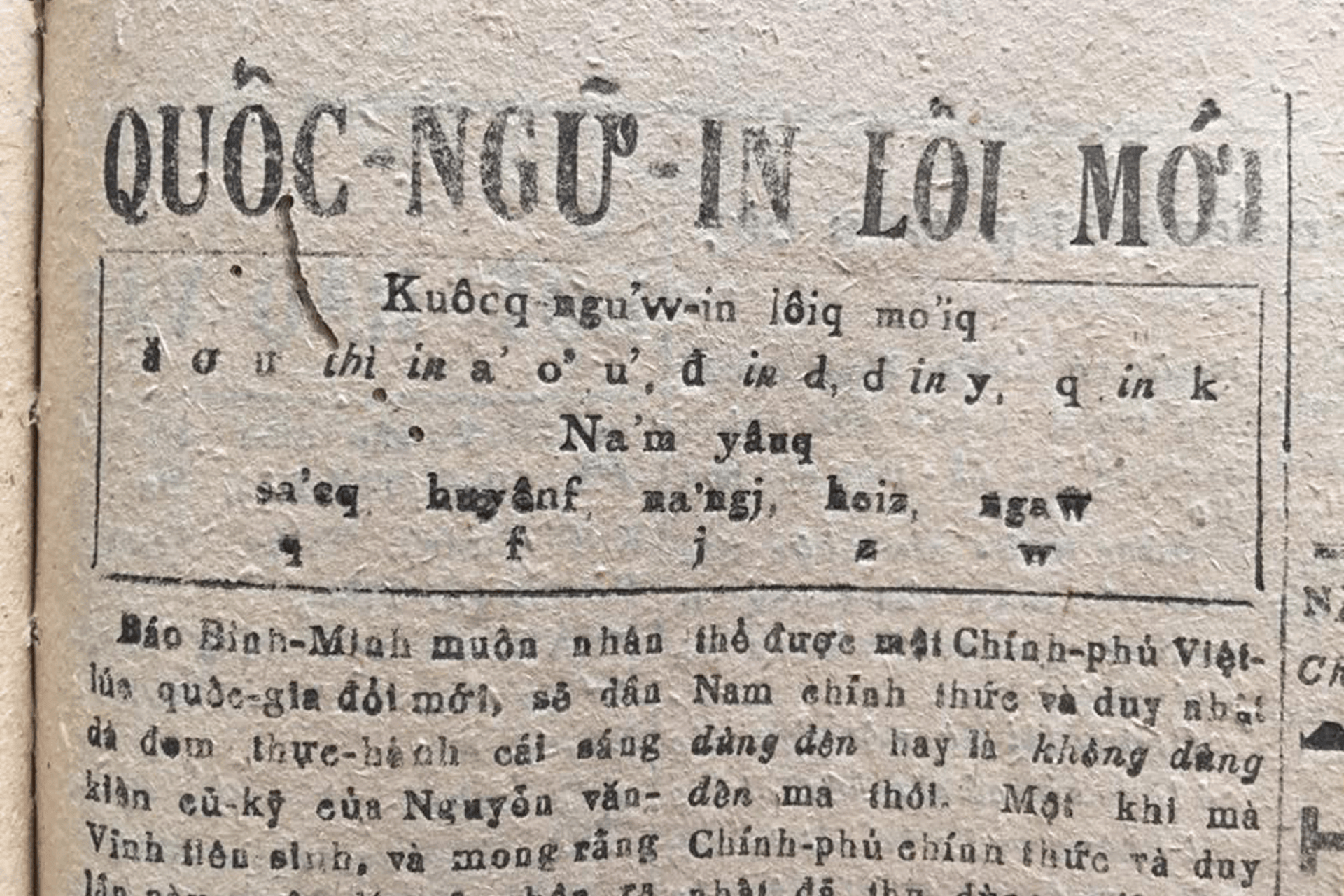
Vietnam has three main regional accents: Northern, Central, and Southern, each shaped by centuries of separate history, geography, and even old royal court influence in the case of Hue.
Think of it the way English speakers think of British English versus American English. The words are mostly the same, the grammar is identical, but the accent, rhythm, and a handful of everyday words differ enough that you can usually tell where someone is from within a sentence or two.
Vietnamese works the same way:
- Northern Vietnamese is often considered the “standard” accent (it’s what’s taught in schools and used in national media).
- Southern Vietnamese sounds softer and drops certain consonant distinctions.
- Central Vietnamese, especially the Hue dialect, is famously the hardest for other Vietnamese people to understand, thanks to its unique vocabulary and fast, flat delivery.
Here’s a quick side-by-side look at how the same everyday words shift by region:
| Meaning | Northern (Hanoi) | Central (Hue…) | Southern (Saigon…) |
| “this” | này | ni, nì | rày, nè |
| “that / that one” | ấy, nớ, tê | đó | đó |
| “like that / so” | thế, rứa (rứa tề) | rứa, dị đó | dị, dị đó |
| “that (over there)” | tê / tề | đó | đó |
| “where” | đâu | mô | đâu |
| “which” | nào | mồ | nào |
| “how / what” | sao, răng | sao, răng | sao |
| “I / me” | tôi | tôi, tui | tui, tôi |
| “I” (informal/rough) | tao | tau, ta | tao |
| “you” (informal/rough) | mày | mi | mày |
| “he/she/it” | nó | hắn | nó |
| “he” (that man) | ông nớ | ông nớ | ổng |
| “she” (that woman) | bà nớ | bà nớ, mụ nớ, mệ nớ | bả |
| “she” (miss/aunt) | cô ấy, dì nớ | dì nớ, o nớ | cổ |
| “she” (older sister) | chị ấy, chị nớ | chị nớ, ả nớ | chỉ |
| “he” (older brother) | anh ấy, anh nớ | anh nớ | ảnh |
What surprises most foreigners isn’t that the accents exist. It’s how different they actually are. Many travelers expect Vietnamese to sound roughly the same everywhere, but the gap between Hanoi and Ho Chi Minh City often catches people off guard. A few patterns worth knowing:
- Northerners pronounce “tr” as a hard, distinct sound; Southerners often soften it closer to “ch.”
- Northerners roll the “r”; in the South, it shifts toward a “g” sound.
- The Hue accent is fast, flat, and full of local vocabulary; even Vietnamese people from other regions sometimes struggle to keep up.
Greetings shift too, not just accent. If you’ve learned Vietnam language from YouTube or an app, you probably picked up “Xin chào” as the standard hello. In Ho Chi Minh City, though, you’re just as likely to be greeted with a simple “Chào anh,” “Chào chị,” or even just “Dạ” – shorter, warmer, and more personal than the textbook version. It’s a small detail, but it’s often the first thing that makes travelers realize spoken Vietnamese and “textbook Vietnamese” aren’t quite the same thing.
So which accent should you actually learn?
- Moving to Vietnam long-term? Northern (Hanoi) is the standard taught in schools and used in national media, the safest foundation.
- Backpacking or traveling loosely? Southern is widely understood and considered easier to pronounce for beginners.
- Just visiting for a trip? Don’t overthink it. Vietnamese speakers across all three regions understand each other, and they’re used to adjusting for outsiders too.
For a deeper look at how North and South Vietnam differ beyond language, see our full breakdown here: 23 Differences from South to North Vietnam
Why Vietnamese Doesn’t Have a Simple Word for “You”
One thing that catches almost every traveler off guard: the Vietnam language doesn’t have a single, neutral word for “you.” Instead, the pronoun changes based on the age, gender, and relationship between the speaker and the listener – a system rooted in Vietnam’s respect for hierarchy and family structure.
Calling a young stranger “bác” (a term for someone your parents’ age) or an older shopkeeper “em” (used for someone younger than you) can feel genuinely awkward, even if the listener won’t say anything.
For travelers, there’s a simple shortcut: “anh” (for a man roughly your age or older) and “chị” (for a woman roughly your age or older) are almost always a safe, polite default. Locals don’t expect visitors to get this perfectly, but using some version of it, rather than skipping pronouns altogether, tends to make conversations feel warmer immediately.
Can I Get By With English in Vietnam?
Short answer: yes, especially in the places most travelers actually go, but it depends heavily on where you are and who you’re talking to.
In big cities and tourist hubs like Hanoi, Ho Chi Minh City, Da Nang, and Hoi An, English is genuinely easy to find. Hotels, restaurants, and tour operators deal with international visitors daily; menus are often bilingual, and younger staff are typically comfortable with basic conversation.
Once you head into rural areas – small villages, local markets, off-the-beaten-path destinations, English drops off quickly, especially among older residents. That’s not a reason to avoid these places; it’s part of what makes them feel authentic. It just means relying more on gestures, translation apps, or a guide.

Generational gap matters more than location. Younger Vietnamese people, especially urban under-35s, grew up learning English in school and consuming it through social media and pop culture, so many speak it comfortably. Older generations in the countryside often grew up with French or Russian as a second language, if any, and that’s where most travelers hit a real communication wall. We explore this cultural and generational gap further in our guide to the Vietnamese people.
Here’s the honest take from running tours across Vietnam: you can absolutely travel independently with just English and a translation app, and it works fine for hotels, restaurants, and major attractions. But Vietnam’s richest moments often happen exactly where English isn’t spoken, and that’s where a local guide adds the most value, not as a translator, but as a bridge into conversations you’d otherwise miss.
Essential Vietnamese Phrases That Actually Work
You don’t need fluency to travel well in Vietnam; you need about ten phrases, said with a smile, at the right moment. Locals are usually delighted when visitors even attempt the Vietnam language, tones and all, so don’t worry about sounding perfect. Here are the ones that get used constantly, with pronunciation written the way an English speaker would actually say it (not formal linguistic notation):
Vietnam Language: Greetings & basics
| English | Vietnamese |
| Hello | Xin chào |
| Thank you | Cảm ơn |
| Sorry / Excuse me | Xin lỗi |
| Yes | Vâng (North) / Dạ (South) |
| No | Không |
| Please | Làm ơn |
| How much is this? | Bao nhiêu tiền? |
| Goodbye | Tạm biệt |
Vietnam Language: Getting around
| English | Vietnamese |
| Go straight | Đi thẳng |
| Turn left | Rẽ trái |
| Turn right | Rẽ phải |
| Stop here, please | Dừng ở đây |
| How far is it? | Bao xa? |
| I want to go to… | Tôi muốn đi đến… |
| Airport | Sân bay |
| Bus station | Bến xe |
| Train station | Ga tàu |
| Motorbike taxi | Xe ôm |
| Is it near/far? | Gần hay xa? |
A few practical notes worth including for travelers:
- “Bao nhiêu tiền?” is arguably the single most useful phrase in the country — from taxis to markets to street food stalls, you’ll use it daily.
- “Xe ôm” is worth knowing on its own. It literally means “hug vehicle,” since you hold onto the driver as you ride. Ride-hailing apps like Grab and Green SM have made things much easier in major cities, but once you head into mountainous regions or smaller, non-touristy areas, traditional xe ôm drivers are often still your best (or only) option. Either way, it remains one of the cheapest, fastest ways to get around in Vietnam.
- Rẽ trái / Rẽ phải pronunciation genuinely shifts by region (the “r” sounds like a “z” in the North and closer to a “y” in the South), a good callback to the earlier accent section rather than a contradiction.
- You’ll notice tones aren’t marked here. That’s intentional. At a beginner level, getting the word roughly right and gesturing (pointing at a map, holding up fingers) works better than trying to nail six tones from a phonetic guide. Drivers and locals are very used to filling in the gaps.
Tips From a Local Guide: Communicating Without Speaking Vietnamese
Here’s what we’ve noticed: the travelers who connect best with locals aren’t the ones who know the most Vietnam language words; they’re the ones who communicate well without words. A few things that consistently work, no matter where you are in the country:
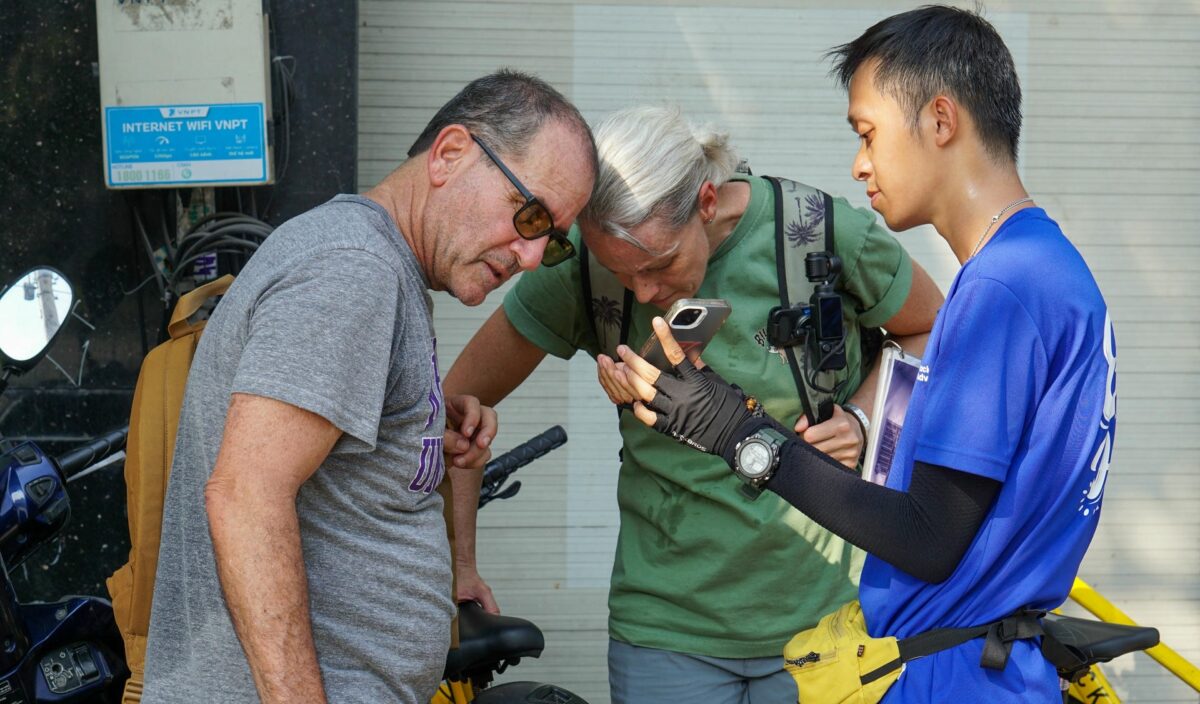
- Use your phone as a translator, but keep it simple. Apps like Google Translate work well for short phrases and menus, but long sentences often come out garbled in the Vietnamese language. Type short, direct phrases rather than full explanations. “Where is bathroom?” translates far more reliably than “Excuse me, could you tell me where I might find a restroom?”
- Photos beat sentences. Showing a picture of a dish, a hotel name, or a destination is often faster and more accurate than trying to say it out loud, especially for unfamiliar place names or food you can’t quite describe. This trick is especially useful with ride-hailing drivers; addresses in Vietnam can be genuinely tricky to find even for locals, so screenshotting your exact pin location saves everyone a lot of confusion.
- Vietnamese daily interactions follow familiar patterns, so you don’t need long explanations. Shopping, ordering food, hailing a ride, asking directions, these all run on a handful of predictable exchanges: “Where to?”, “How much?”, “What would you like?” Once you recognize the pattern, you can respond without needing full sentences, pointing at what you want, holding up cash, or tapping a number on your phone is usually all it takes for locals to understand exactly what you mean.
- Numbers and gestures go a long way. Holding up fingers for quantities, pointing at items on a menu or at a market stall, and using a calculator app for negotiating prices are all normal, you won’t come across as rude or lazy for using them. And while we’re on practical etiquette, knowing how tipping works in Vietnam helps too.
- Smile first, talk second. Vietnamese communication relies heavily on tone and warmth, not just words. A friendly smile and a slight nod go further than perfect grammar, and locals are generally very patient and quick to meet you halfway once they sense goodwill.
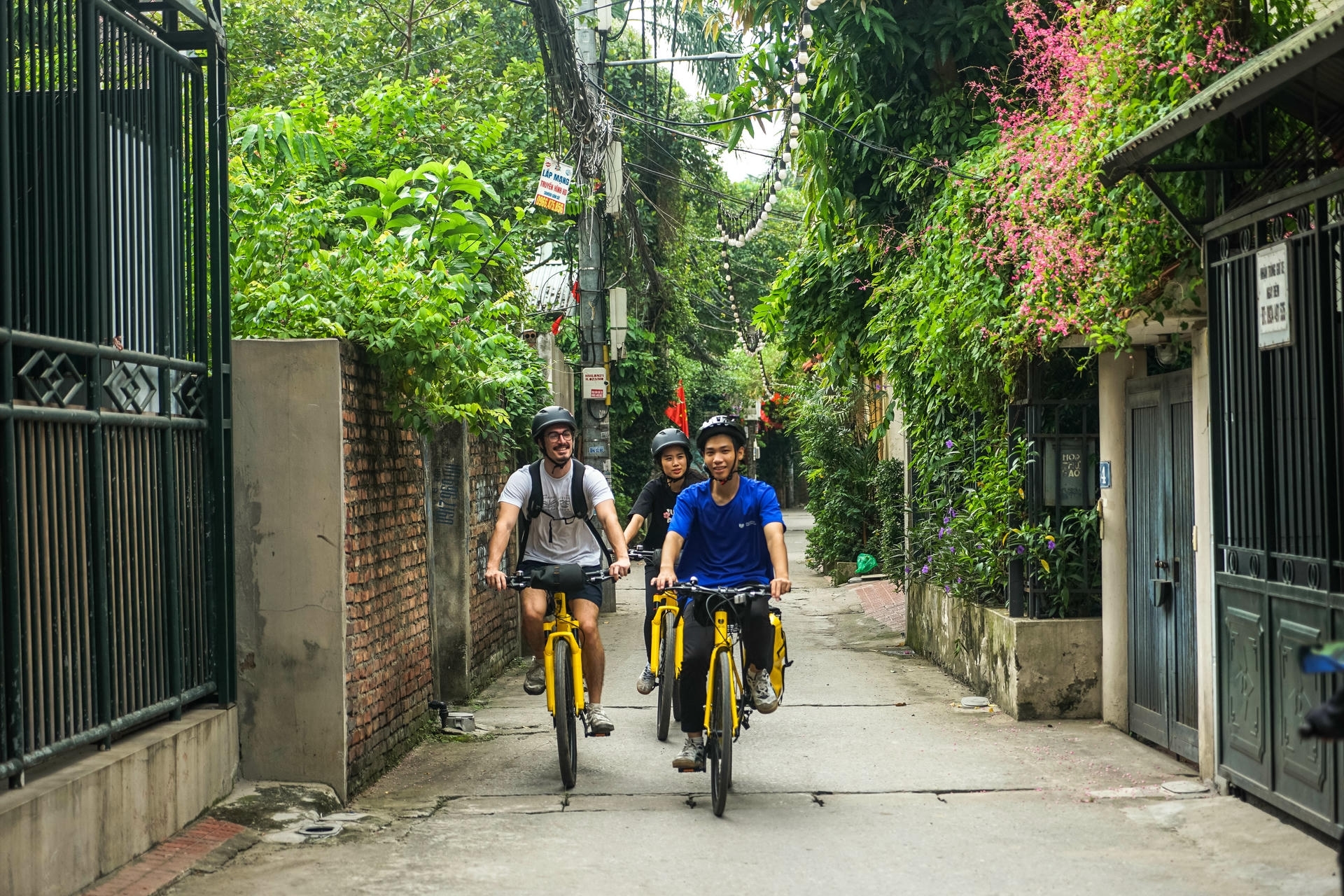
- When it really matters, lean on a guide. There are moments: bargaining respectfully at a local market, asking an elderly street vendor about her recipe, navigating a situation that needs more nuance than gestures allow, where a bilingual, bicultural guide isn’t just helpful, it’s the difference between watching Vietnam and actually participating in it. It’s exactly why our cycling tours in Hanoi and Saigon and Saigon electric tours are always led by local guides — so those small roadside conversations, the ones that don’t translate well through an app, become part of the trip instead of getting lost in it.
We’ve seen this happen more times than we can count. A guest picks up “cảm ơn” before lunch, half-jokingly practices it in the van, then actually uses it on a street vendor an hour later, and gets a genuine, surprised smile back, the kind that says nobody expected you to try that. By the end of the day, the same person who couldn’t pronounce “xin chào” that morning is confidently ordering their own coffee, no translation app in sight. That moment – the smile, the small shock on both sides – tends to matter more to people than they expect going in. It’s rarely about the words themselves. It’s the feeling of being met halfway.
FAQs About Vietnam Language
Final Thoughts on the Vietnam Language
Mastering the Vietnam language could take years. Traveling here doesn’t take nearly that long; a handful of phrases and some patience with gestures will carry you further than you’d expect. The barrier that looks intimidating from home rarely holds up once you’re actually navigating a market or chatting with a xe ôm driver.
And maybe that’s the real charm of it. You don’t need perfect words to feel close to a place. Sometimes it’s a shared laugh over a mispronounced tone, or a vendor patiently repeating a phrase until you get it right, that ends up staying with you longer than any landmark. If you ever find yourself cycling past rice paddies near Ancient Cổ Loa, let those small moments happen; they’re usually where Vietnam actually introduces itself to you.